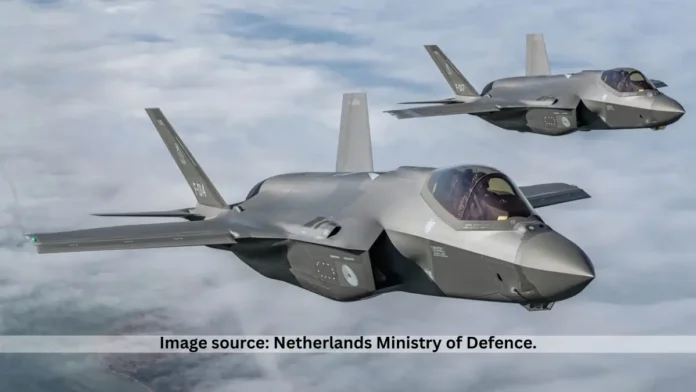
The US – Iran war situation is well known around the world, where Iran is confronting the US in unexpected ways. The recent situations have shocked everyone around the world when Iran hit the advanced fighter jet F-35 of the US, which is also called the Ghost.
What is the F-35, and why is it called Invisible?
The F-35 Lightning II is a fifth-generation multi-role stealth fighter jet designed by Lockheed Martin that performs ground attack, reconnaissance, and air defense missions which operates under US Department of Defense’s Foreign Military Sales program and being sold to US’s international partner like UK, Italy, Japan, South Korea, Belgium, Australia, Norway, Denmark, Netherlands, Israel and others.
What’s so special about the F-35 Lightning II?
The cutting-edge technology of the F35 makes it difficult to trace through radar, especially traditional radar, and it can operate in contested environments with less risk of detection when combined with electronic warfare and sensor fusion.
Why F35 is called Invisible
The F35’s advanced technology enables its structure to minimize radar cross-section, which means detection systems get very little radar signal back. Thus, stealth does not mean completely invisible; instead, it makes detection through the radar system more difficult, especially against traditional radar systems.
Why the “F-35 Ghost” Narrative Matters
Recent circumstances and viral discussions have raised a critical question in modern warfare: are advanced stealth jets detectable? The discussion currently revolves around the US’s F-35 Lightning II, often referred to as “ghost” (due to its near-invisibility to radar). The sudden spotlight on it as Iran claims to detect and even hit such aircraft, which raises the debate on the future of stealth technology and air superiority.
What Exactly Did Iran Claim?
The sources from Iran have suggested that Iran’s air defence system successfully detected the F35 when operating in their region. Some reports add up to the claims of a successful strike or forced landing.
Difference you should know:
- Tracking: Identifying the presence of an aircraft
- Targeting: Locking onto it with weapons systems
- Hit/Strike: Successfully damaging or downing it
Latest Claim: Iran Shot Down 2nd F35
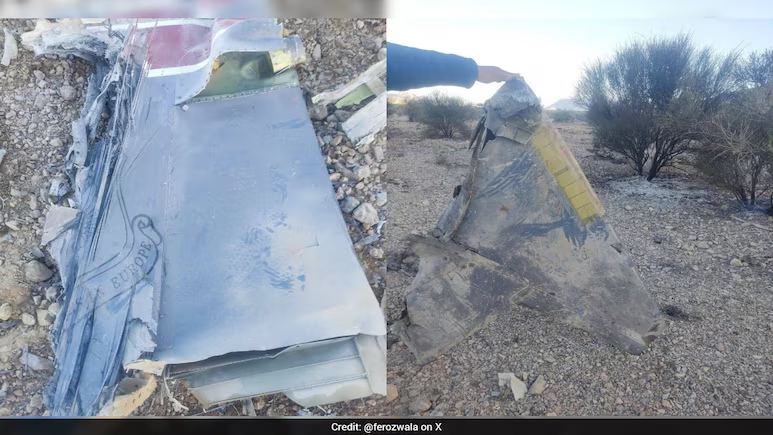
While previous claims are still not verified, there is another claim by Iran of a shootdown of a second F35 in central parts of the country, amid ongoing escalation since the 28th of February. Washington rejected the previous claim made on the 19th of March. The US is yet to respond to this claim.
As per the reports of Iranian news media Tasnim News Agency, the IRGC claims a second F35 being destroyed in the skies of F-35. Where there is also images circulating of wreckage said to be an American jet, but yet to be verified if it was F35.
Can Stealth Aircraft Actually Be Detected?
Yes, when certain conditions are met.
The stealth technology comes with its own limitations, as it primarily reduces detection by high-frequency.
Sometimes, stealth shapes can be detected by low-frequency radar
Heat emissions can’t be avoided
Detection also relies on angle, distance, and environment.
In summary, stealth reduces the chance of being detected but doesn’t eliminate it completely.
How Iran May Have Detected the F-35
Infrared Search and Track (IRST) Systems
IRST is currently one of the most believable reasons, as these sensors detect the heat signatures instead of radar detections. The jet engines produce an immense amount of heat, which makes them still detectable even if radar signatures are very low.
Passive Detection Systems
The Passive detection follows the electromagnetic activity in the environment rather than emitting signals like traditional radar systems, which makes them potentially strong against stealth aircraft.
Multi-Static Radar and Networked Defense
There are also possibilities that Iran might have installed multiple radar systems in different locations to share data. This provides a more detectable picture and assists in identifying aircraft from multiple angles.
Signal Intelligence (SIGINT)
SIGINT is also another way, as it intercepts electronic signals emitted by the aircraft, since stealth aircraft also emit certain levels of electronic signals during operations.
Was the F-35 Really Hit? Fact vs Speculation
Currently, no confirmed evidence proves Iran managed to hit F35. While the US Central Command (CENTCOM) has rejected such claims and states that no U.S. aircraft have been destroyed by Iran, while Iran claims to have seriously damaged an F-35 on March 19, 2026.
But CENTCOM confirmed that the F-35 made an emergency landing at a U.S. base in the Middle East around March 19, 2026, following a combat mission over Iran
Why This Incident Is a Big Deal Globally
If Iran really did manage to detect and hit, then it would challenge the perception of stealth tech dominance at various levels:
- Questions over U.S. air superiority
- Increased focus on counter-stealth technologies
- Potential impact on defense exports and alliances

