

For millions of students, an examination isn’t just a test; it’s years of preparation, sacrifices, and the hope of building a better future.
That’s why every paper leak feels personal.
It isn’t just about an exam being cancelled. It’s about months of hard work being put on hold because someone somewhere found a way to exploit the system.
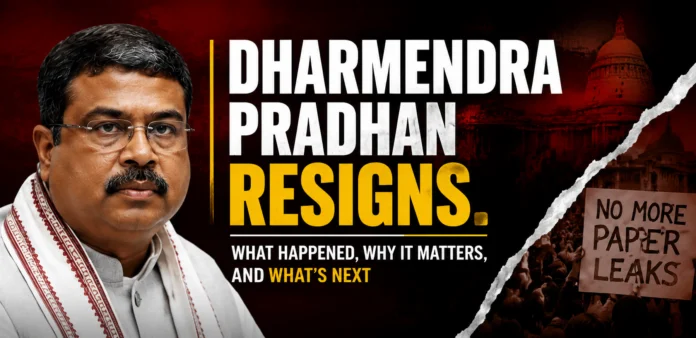
Following the recent controversy, Union Education Minister Dharmendra Pradhan stepped down today, 25.07.26. Many students and political groups celebrated the resignation as a major victory.
But once the celebrations settle, one question remains:
Has India’s examination system actually become safer?
The answer is far more complicated than a resignation.
Because while individuals can be held accountable, systemic problems don’t disappear with a change in leadership.
The Current Situation
India conducts some of the world’s largest examinations every year, from NEET and CUET to recruitment exams for government jobs.
These exams decide admissions, careers, and livelihoods for millions.
Yet, paper leaks have become a recurring problem. Every new controversy leaves students asking the same questions:
- Will the exam be cancelled?
- Will I have to prepare again?
- Can I trust the system?
When these questions become more common than discussions about merit, it’s clear the issue is bigger than a single incident.
Dharmendra Pradhan’s Statement While Resigning
While stepping down, Dharmendra Pradhan accepted moral responsibility for the controversy and reiterated the government’s commitment to protecting students’ interests and strengthening the examination system.
In any democracy, accountability matters.
When something affects millions of students, it’s natural for people to expect responsibility from those leading the system.
His resignation fulfilled that expectation.
But accountability should be the beginning of reform, not the end of it.
What Measures Did the Government Take?
Along with the resignation, the government announced several steps to strengthen examination security:
- High-level investigations into the leak.
- Action against organised paper leak networks.
- Review of existing examination security protocols.
- Increased use of technology to secure examinations.
- Expansion of computer-based testing where feasible.
- Tougher action against those involved in examination fraud.
These are positive steps.
However, students have heard promises before. The real test will be whether these measures prevent the next paper leak, not just respond to the last one.
Is It Really a Victory for Students?
Many students see the resignation as proof that public pressure works.
And in one sense, they’re right.
Holding leaders accountable is an important part of democracy.
But students didn’t spend years preparing just to see a minister resign.
They prepared for a fair examination.
If the systems responsible for creating, printing, storing, and distributing question papers remain largely unchanged, then the biggest concern still exists.
The real victory will come when students stop worrying about paper leaks altogether.
The Risk of Another Paper Leak Still Exists
Changing a minister doesn’t automatically change the system.
A question paper typically passes through multiple stages before reaching an examination hall:
- Question setters
- Moderators
- Printing agencies
- Storage facilities
- Transportation
- Examination centres
Every additional hand that touches the paper creates another point of risk.
Until those vulnerabilities are reduced, another leak remains possible.
The goal shouldn’t be finding someone to blame after every incident.
It should be making leaks far more difficult in the first place.
The Problem With Selective Outrage
Paper leaks aren’t limited to national exams.
Punjab has witnessed recruitment exam leaks and irregularities that resulted in investigations and cancelled examinations. Karnataka has also faced recruitment exam controversies involving alleged paper leaks, impersonation, and organised cheating networks.
Yet, these incidents rarely receive the same nationwide attention.
Students deserve equal concern regardless of whether an exam is conducted by the Centre or a state government. A paper leak is a systemic failure, not a political issue.
Why Forced Resignations Alone Aren’t Good for the Country
Holding public officials accountable is necessary.
But if every major administrative failure ends with a resignation and little else, the country risks repeating the same cycle.
Leadership changes may satisfy public anger, but they don’t automatically strengthen institutions.
Large education reforms take years to design and implement. Constant leadership changes can slow those efforts if they aren’t accompanied by long-term policy continuity.
The focus shouldn’t be just on replacing people.
It should be on fixing the processes that failed in the first place.
What Could Actually Solve the Problem?
India doesn’t need more reactive solutions.
It needs preventive ones.
One practical step would be building a secure centralised digital examination portal where question papers remain encrypted and inaccessible until shortly before the exam begins.
Access could be restricted using:
- Multi-factor authentication
- Time-based access controls
- Complete audit logs
- Limited authorised users
- Real-time monitoring
Where infrastructure permits, more examinations could also gradually shift towards computer-based testing, reducing dependence on physical printing, transportation, and storage.
Combined with independent cybersecurity audits and stronger operational oversight, these changes could significantly reduce the opportunities for paper leaks.
The Real Victory Students Deserve
Students aren’t asking for political victories.
They’re asking for certainty.
They want to know that if they spend months or even years preparing for an examination, their future won’t be decided by someone else’s corruption.
Every paper leak chips away at trust.
Rebuilding that trust requires more than arrests, resignations, or political debates.
It requires a system where integrity is built into every stage of the examination process.
Final Thoughts
Dharmendra Pradhan’s resignation is an important moment, and for many students, it represents accountability.
But accountability alone won’t stop the next paper leak.
Unless the examination system itself becomes more secure, the country risks finding itself in the same position again, just with a different minister.
India has the technology and the capability to build a more secure examination ecosystem.
The question is no longer whether reform is needed.
It’s how quickly those reforms can be implemented before another generation of students pays the price.
Opinion: Frequent forced resignations can create an incentive for political actors to focus more on building public pressure and demanding resignations than on institutional reforms. In my view, this risks keeping the country in a cycle of recurring protests and political instability, where governments spend more time responding to crises than implementing long-term reforms. If this pattern continues, it would not be surprising to see more protests over future controversies, with resignation becoming the primary demand instead of systemic change.

